
An allergic reaction usually shows its full hand within the first hour, so the next sixty minutes tell you whether your pet is past the worst or heading into it. Anaphylaxis, the most dangerous form, declares itself within minutes of a sting, bite, or new medicine: vomiting, drooling, gums that lose their colour, and collapse can follow fast in both dogs and cats. Hives and a swollen face sit a rung lower, often surfacing within the hour and sometimes creeping worse before they settle, so a pet who looks mildly affected still needs watching. The slow-burning kind, skin that itches and flares over weeks rather than minutes, runs on an entirely different clock, though it is the same immune system overreacting underneath.
The Vale Veterinary Group keeps emergency cover running day and night for registered clients across our Devon centres, so a pet in the grip of a serious reaction is never waiting for morning. We can stabilise a pet who is suddenly unwell and then work out what set the reaction off, while our dermatology services take on the chronic version of allergic disease. A sting at dusk or a swelling you cannot explain is worth a call at any hour, so ring us straight away rather than waiting it out and come in to see us in Uffculme, Collompton, Tiverton, or Honiton.
The Three Speeds of an Allergic Reaction
- Allergic reactions sort into three tiers: slow-burning skin allergies you manage over months, hives or facial swelling that want same-day attention, and anaphylaxis that needs a vet immediately.
- Anaphylaxis looks different by species: dogs often show sudden vomiting, diarrhoea, and collapse, while cats show open-mouth breathing, which is always abnormal in a cat.
- A severe reaction can return in a second wave hours after your pet seems recovered, which is why we keep patients monitored well past the point they look better.
- Getting on top of a chronic allergy means treating the underlying cause with parasite cover, the right medication, allergy testing, and skin support, not just chasing each infection as it appears.
Which Pets React, and What Sets Them Off?
Any dog or cat can develop an allergy, though it usually surfaces between one and three years old, and some breeds are far more prone than others. Whatever the pet, the trigger almost always traces back to one of three things: the environment, the diet, or insects and parasites.
- Environmental: The most common allergic skin disease we see, atopic dermatitis, is driven by what a pet breathes in or absorbs through the skin, with pollen, grass, mould spores, and house dust mites topping the list. These flares often begin seasonally and creep towards year-round as a pet ages.
- Dietary: A genuine food allergy usually points to a specific protein such as beef, dairy, or chicken, and it tends to itch and upset the stomach all year rather than in spring-and-summer bursts.
- Insects and parasites: Flea bites are the single most reactive trigger of the lot. Bee or wasp stings, so common on a Devon summer evening, can set off anything from a puffy face to a whole-body emergency.
Is a Reaction to a Jab or a New Medicine Worth Worrying About?
Most pets are vaccinated without any bother, and mild soreness or a quiet evening afterwards is normal. The vaccine reactions that warrant a call are facial swelling, hives, repeated vomiting, or collapse in the hours after the appointment, which are uncommon but worth acting on quickly.
The same logic applies to medicines. Antibiotics, pain relief, and sedatives can all occasionally trigger a reaction, so tell us about any past intolerance before we reach for a new prescription. We review vaccine history and previous reactions at every set of annual health checks and vaccinations, and we make a plan personalised to their individual health needs.
How Do I Tell How Serious My Pet’s Reaction Is?
Reading the urgency comes down to three tiers, and the difference is how fast your pet needs to be seen. The full range of allergic reactions in dogs and cats maps cleanly onto them.
| Tier | What you might see | What to do |
| Manage over time | Ongoing itch, recurring ear trouble, licked-raw patches | Book a routine appointment |
| Same-day care | Hives, a swollen face, persistent vomiting, an asthma-type flare | Phone us and come in today |
| Emergency | Struggling to breathe, collapse, weakness, pale or blue gums | Ring ahead and come straight in, day or night |
For that bottom row, ring our nearest centre; registered clients have cover at any hour. While you’re on your way in, a few simple things help:
- Stay calm so your pet stays calm, since anxiety makes any breathing trouble worse.
- Note the timing and any trigger, whether a sting, a new food, a fresh treat, or a recent jab.
- Skip the home remedies: do not try to make your pet sick and do not reach for human tablets without checking with us first.
- Bring the culprit if you safely can, whether that’s the packaging, the plant, or a quick photo.
- Watch the breathing and the colour on the journey in.
Lifting the lip to check the gums is a quick read on the way in: healthy gums are bubble-gum pink, and pale or bluish gums point to poor circulation or oxygen delivery that shouldn’t wait.
What Does Long-Term Allergic Skin Disease Look Like?
Long-term allergy shows up in the skin and ears rather than as a sudden crisis, and dogs and cats show it differently.
Chronic Skin Reactions in Dogs
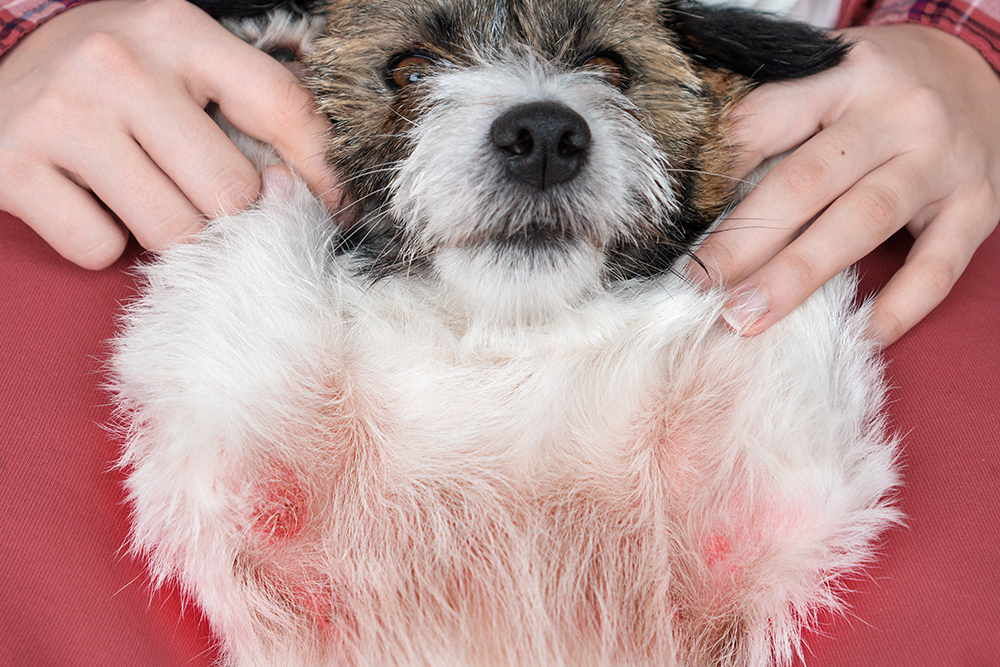
A dog with allergies usually gives themselves away at the paws, ears, belly, and armpits, with constant chewing, pink irritated skin, thinning fur, and ears that keep flaring. A dog who latches onto one itchy patch can raise a hot spot within hours, turning a small irritation into a raw, weeping area where licking has triggered a secondary infection.
Inflamed, saliva-stained toes (pododermatitis) are often the earliest visible sign, and when licking damages the skin deeply enough for a hair follicle to rupture, painful nodules called interdigital furunculosis can form between the toes. Because the ear canal is really just a fold of skin, allergic dogs also slide into chronic otitis externa, the recurring ear infections so many households know well.
Chronic Skin Reactions in Cats
Cats groom in private, so allergic itch usually turns up as neat, symmetrical bald patches from overgrooming rather than any scratching you ever see. Two other patterns round out the feline picture: miliary dermatitis scatters tiny crusty bumps that feel like grains of sand along the back, while eosinophilic granuloma complex brings ulcers or raised plaques, often on the lips, tummy, or back legs.
Contact Reactions to Everyday Products
Some reactions have nothing to do with pollen or fleas and everything to do with what a pet lies on. Contact hypersensitivity develops where skin meets an irritant, usually laundry detergents, fabric softeners, new rugs, floor cleaners, and grooming products, and because it needs direct contact, it shows up on the thin or hairless skin of the belly, groin, and between the toes. Swapping one product at a time often reveals the culprit.
When Do Hives and a Swollen Face Need Same-Day Care?
Hives and a puffy face sit in the same-day tier, uncomfortable and worth a prompt look but not usually an instant emergency on their own. Any breathing change, drooling, or vomiting alongside them, though, tips the picture straight into come-in-now territory.
- Hives are raised welts that surface within minutes to a few hours of exposure, and dramatic as they look, they’re sometimes only the opening act of a reaction that’s still building.
- Allergic bronchitis and feline asthma can flare fast when allergies kick in, and wheezing or a sudden cough deserves a prompt call.
- Insect stings usually settle within a few hours, but they turn urgent when they land on the face, mouth, or throat, when several arrive at once, or when whole-body signs build alongside the swelling.
If your pet’s breathing has changed, hives are getting worse instead of better, or a wasp sting swelling isn’t receding, call us right away and we’ll direct you on what to do.
When Does an Allergic Reaction Become a Life-Threatening Emergency?
Anaphylaxis is the reaction that can’t wait, usually erupting within minutes of a trigger. What makes it tricky is that it looks quite different in dogs and cats, so it can be missed if you’re watching for the wrong signs.
In dogs, anaphylaxis often hits the gut first, with sudden vomiting, diarrhoea, weakness, collapse, and pale gums making a picture so gastrointestinal it’s easily mistaken for severe food poisoning. In cats the picture is reversed: anaphylaxis in cats targets the lungs, so the first sign is often severe breathing difficulty and open-mouth breathing, which is never normal in a cat and always signals an emergency.
How Do We Treat a Pet in the Grip of a Reaction?
Treatment splits along the same lines as the reactions: fast, intensive care to reverse shock and support breathing for an anaphylactic emergency, and a longer game of calming the itch and clearing infections for chronic skin and ear disease.
Emergency and Acute Reactions
When a pet arrives mid-reaction, the first job is getting them stable before the reaction does lasting harm. Part of why these patients get such aggressive care with oxygen, intravenous fluids, and adrenaline is that respiratory distress can return hours later in a delayed second wave called a biphasic reaction, so we keep monitoring well past the point a pet looks recovered. For the small number of pets with a confirmed history of severe anaphylaxis, we may discuss keeping an adrenaline pen at home for the trip in, though that’s case-by-case rather than routine.
Chronic Skin and Ear Disease
The first task when controlling severe allergic skin disease is getting your pet comfortable: starting anti-itching medications and then finding the secondary infections hiding in inflamed skin and ears. This is where in-house cytology (a skin or ear sample under the microscope) comes in. From there, the aim is to treat the underlying allergy rather than clear the same ear infection again and again, usually by combining several approaches instead of leaning on one drug. Settling an itchy pet often takes a few visits with our small animal team to find the combination that holds, since every pet’s allergic triggers and severity are different.
Can You Actually Prevent Allergic Flare-Ups?
You can’t switch off an allergic tendency, but you can dramatically cut how often and how hard it flares.
Parasite Prevention for Allergic Pets
For a sensitised pet, a single bite is all it takes: flea allergy dermatitis is among the most common skin conditions in dogs and cats, and one flea can set off weeks of frantic itching long after it’s gone. That’s why year-round parasite prevention is non-negotiable for an allergic pet, even one whose main problem is pollen or food. Keeping it topped up all year, something our Premier Paws Club makes routine, closes that gap.
Prescription Medications
When a pet needs fast relief, a JAK inhibitor such as Apoquel can switch off the itch signal within hours rather than days, sparing a lot of self-inflicted skin damage. It’s far from the only option, and the right choice depends on the pet, the severity, and how long the relief needs to last.
| Medication | What it is | Where it fits |
| Apoquel, Zenrelia, Numelvi | JAK inhibitor tablets | Fast, flexible itch control |
| Cytopoint | Antibody injection | Steady monthly cover for atopic dermatitis |
| Atopica | Immune-modulating capsule | More severe or long-standing cases |
| Corticosteroids | Steroids | Short bursts to calm an acute flare |
| Antihistamines | Over-the-counter type | Help a subset of pets, worth a trial |
Allergy Testing and Immunotherapy
Rather than only muting symptoms, immunotherapy gradually retrains the immune system to tolerate a pet’s specific environmental triggers through tailored sublingual drops or desensitising injections over roughly twelve to eighteen months. It begins with proper allergy testing, either an intradermal skin test or a blood test, to pin down what a pet actually reacts to. Skip the hair and saliva kits sold straight to the public: they’re unreliable and flag allergies that aren’t there.
Grooming and Skin Support at Home
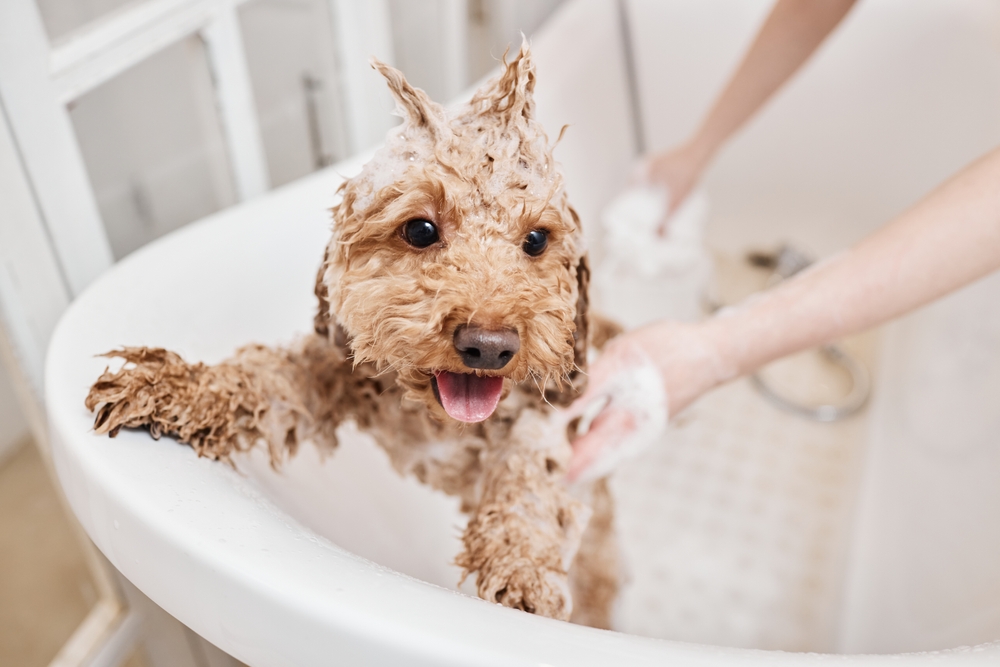
Simple home care takes real pressure off the skin. Regular grooming lifts allergens out of the coat before they’re absorbed or licked off. Medicated shampoos do most of their work in the ten minutes they sit on the skin, so setting a timer beats a quick lather and rinse. A wipe-down after a walk, focused on the feet and hairless areas, clears pollen before it causes trouble, and between-bath sprays, mousses, and wipes handle flares as they come. Over the longer term, omega fatty acids support the skin barrier and take some heat out of the inflammation.
What’s the Best Way to Pin Down a Food Allergy?
No blood test reliably diagnoses a food allergy, so the elimination diet trial is the only dependable way to confirm one: eight to twelve weeks strictly on a novel or hydrolysed protein diet, followed by a deliberate reintroduction challenge. It asks a lot of a household, but it works.
The catch is that it only works if it stays strict. One flavoured tablet, a stolen treat, or a lick of someone’s plate can quietly undo the whole trial. That’s also why over-the-counter “limited ingredient” foods don’t cut it for diagnosis: factory cross-contamination is common enough to muddy the result, so the diet needs to be a prescription one chosen with us and followed to the letter.
Pet Allergies: The Questions We Hear Most
Can I give my dog or cat an antihistamine?
Sometimes antihistamines help, but please check with us first. They can be safe at the right dose for the right pet, yet plenty of human products also contain decongestants or other ingredients that are dangerous for dogs and cats. They’re also nowhere near enough for a severe reaction, so if your pet is swelling or struggling to breathe, an antihistamine isn’t the answer. A quick call tells you whether it’ll help or whether you need to come in.
Will my pet grow out of their allergies?
Growing out of an allergy is uncommon, unfortunately, and most cases stick around or slowly worsen rather than fade. The realistic goal is good control rather than a cure, and with today’s tools most allergic pets live comfortable lives with only mild, infrequent flares.
How can I tell allergies apart from mites or ringworm?
You often can’t tell by looking, because mites, ringworm, and some hormonal conditions can all mimic an itchy allergy. That’s what the workup is for: a couple of quick in-house tests, a skin scrape among them, usually sort out what’s really going on before we commit to a long-term allergy plan. Guessing wrong can waste months.
Allergy Help, Whenever You Need It
Whether your pet has just had a frightening reaction or has spent months quietly itching, the next step is the same: let us work out what their immune system is fighting and build the plan around it. If a reaction is unfolding right now, ring The Vale and head straight in, whatever the hour; for the longer-running itch, book in with your nearest centre and we’ll get started.






Leave A Comment